SETTING THE RECORD STRAIGHT: PETER OBI, TAXATION, AND THE POLITICS OF MISDIRECTION
By Kola Oladeji
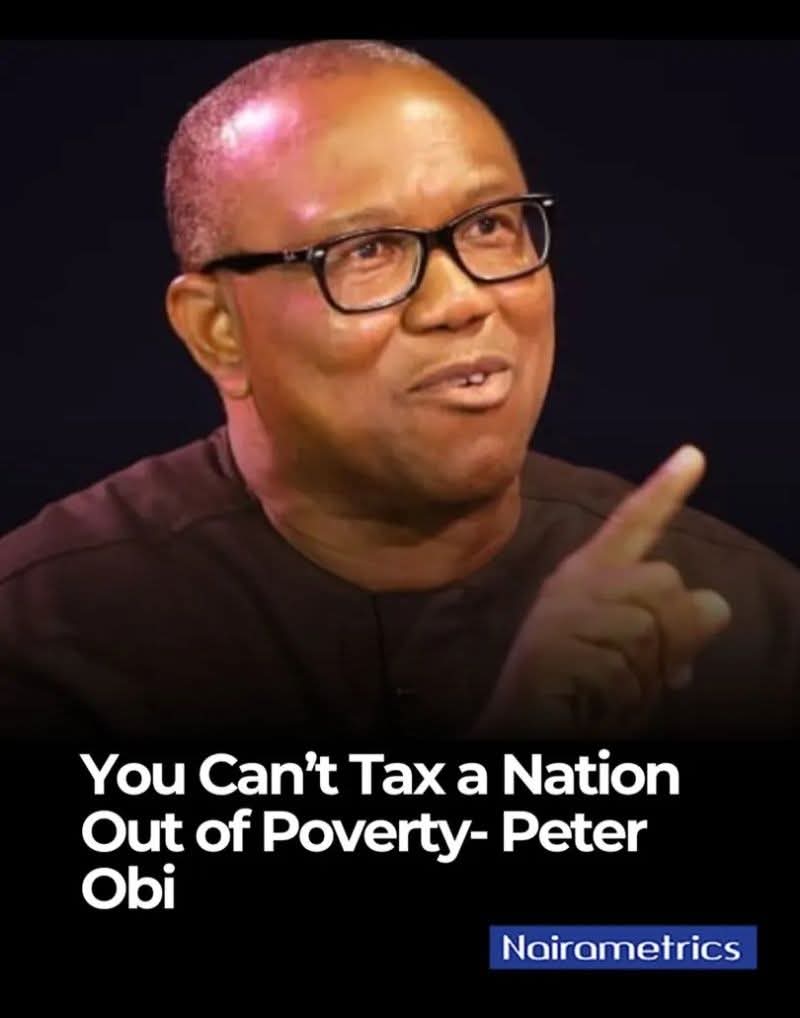 Recent comments credited to former Anambra State Governor, Mr. Peter Obi, opposing the new tax reforms introduced by President Bola Ahmed Tinubu, have once again exposed the deep contradictions in Nigeria’s political discourse.
Mr. Obi has argued that the new tax reforms are insensitive because “Nigerians are hungry.” While the concern for the welfare of Nigerians is legitimate, it is disingenuous and politically opportunistic for Mr. Obi to present himself as an opponent of taxation when historical records clearly show otherwise.
The Facts Nigerians Must Remember
During Peter Obi’s tenure as Governor of Anambra State (2006–2014), his administration introduced and enforced multiple taxes and levies, particularly on traders and small businesses. These policies sparked widespread protests, most notably by traders at Eke Awka Market, who openly resisted what they described as excessive and harsh taxation. This is a matter of public record.
To therefore suggest today that taxation is inherently anti-people is to rewrite history. Even Mr. Obi himself has never denied that taxation is a core tool of governance. In fact, when pressed during previous engagements, he has openly admitted that no serious government can run without taxes, even under his hypothetical presidency.
The question then becomes: why the sudden outrage?
The answer is simple — politics.
Tax Reform Is Not the Enemy
President Bola Ahmed Tinubu’s tax reform agenda is not designed to punish Nigerians but to rescue a fragile economy, expand the tax net, reduce leakages, and ensure that government can fund security, infrastructure, education, healthcare, and social interventions.
No nation develops without sustainable revenue. What matters is not whether taxes exist, but how they are structured, who bears the burden, and how the proceeds are used.
Peter Obi’s Anambra Record: Achievements and Omissions
To be fair, Peter Obi recorded some notable achievements as governor. His administration was often praised for fiscal discipline, modest savings, and a reluctance to borrow excessively. Investments were made in education, especially through partnerships with missionary schools, and his government promoted a culture of accountability.
However, these achievements came with significant costs and contradictions:
Poverty levels in Anambra increased during his years in office, despite claims of prudent economic management.
Traders and small business owners repeatedly complained of multiple taxation and aggressive revenue collection.
Several claims made about internally generated revenue and major taxpayers were later disputed by official state revenue records.
These realities are often left out of today’s carefully curated political narrative.
Leadership Requires Consistency and Honesty
Nigeria is at a critical point in its history. What the country needs is honest leadership and consistent messaging, not selective memory or emotional soundbites aimed at scoring political points.
It is easy to criticise reforms when one is outside government. It is harder to make tough decisions when responsible for over 200 million people and a struggling economy. President Tinubu has chosen the difficult but necessary path.
Conclusion
Nigerians deserve facts, not fear. They deserve informed debate, not political posturing. Taxation is not new, and it is not wicked when applied responsibly. Those who once imposed taxes in power should not pretend to be saints in opposition.
Jamisi Newsline urges Nigerians to look beyond rhetoric, examine records, and judge leaders by consistency, truth, and capacity to govern, not by convenience.
Signed:
Kola Oladeji
Political Analyst & Contributor
Jamisi Newsline